
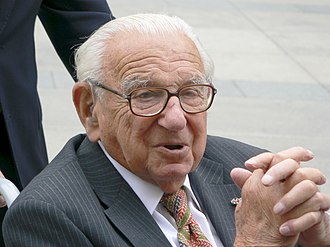
Sir Nicholas George Winton MBE (né Wertheim; 19 May 1909 – 1 July 2015) was a British stockbroker and humanitarian who helped to rescue Jewish children who were at risk of being murdered by Nazi Germany during the Holocaust. Born to German-Jewish parents who had emigrated to Britain at the beginning of the 20th century, Winton assisted in the rescue of 669 children, most of them Jewish, from Czechoslovakia on the eve of World War II. On a brief visit to Czechoslovakia, he helped compile a list of children needing rescue and, returning to Britain, he worked to fulfil the legal requirements of bringing the children to Britain and finding homes and sponsors for them This operation was later known as the Czech Kindertransport (German for 'children's transport').
His humanitarian accomplishments remained unknown and unnoticed by the world for nearly 50 years until 1988 when he was invited to the BBC television programme That's Life!, where he was reunited with dozens of the children he had helped come to Britain and was introduced to many of their children and grandchildren. The British press celebrated him and dubbed him the "British Schindler". In 2003, Winton was knighted by Queen Elizabeth II for "services to humanity, in saving Jewish children from Nazi-occupied Czechoslovakia". On 28 October 2014, he was awarded the highest honour of the Czech Republic, the Order of the White Lion (1st class), by Czech President Miloš Zeman. Winton died on 1 July 2015, at the age of 106.
Early life
Winton was born on 19 May 1909 in Hampstead, London, to Jewish parents Rudolph Wertheim (1881–1937), a bank manager, and Barbara (née Wertheimer, 1888–1978), as the middle of three children. His elder sister was Charlotte (1908–2001) and his younger brother was Robert (1914–2009). His parents were German Jews who had moved to London two years earlier. The family name was Wertheim, but they changed it to Winton in an effort at integration. They also converted to Christianity, and Winton was baptised.
In 1931, he moved to France and worked for the Banque Nationale de Crédit in Paris. He also earned a banking qualification in France. Returning to London, he became a broker at the London Stock Exchange. Though a stockbroker, Winton was also "an ardent socialist who became close to Labour Party luminaries Aneurin Bevan, Jennie Lee and Tom Driberg" Through another socialist friend, Martin Blake, Winton became part of a left-wing circle opposed to appeasement and concerned about the dangers posed by the Nazis.
At school, he had become an outstanding fencer, fencing both foil and epee, and was selected for the British team in 1938. He had hoped to compete in the following Olympics, but the games were cancelled because of World War II.
Rescue work
Shortly before Christmas 1938, Winton was planning to travel to Switzerland for a skiing holiday. Following a call for help from Marie Schmolka and Doreen Warriner, he decided instead to visit Prague and help Martin Blake, who was in Prague as an associate of the British Committee for Refugees from Czechoslovakia, then in the process of being occupied by Germany, and had called Winton to ask him to assist in Jewish welfare work. Alongside the Czechoslovak Refugee Committee, the British and Canadian volunteers such as Winton, Trevor Chadwick, and Beatrice Wellington worked in organising to aid children from Jewish families at risk from the Nazis. Many of them set up their office at a dining room table in a hotel in Wenceslas Square. Altogether, Winton spent one month in Prague and left in January 1939, six weeks before the German occupation of Czechoslovakia. Other foreign volunteers remained, such as Chadwick, Warriner and Wellington. In November 1938, following Kristallnacht in Nazi-ruled Germany, the House of Commons approved a measure to allow the entry into Britain of refugees younger than 17, provided they had a place to stay and a warranty of £50 (equivalent to £3,397 in 2021 was deposited per person for their eventual return to their own country
Netherlands
An important obstacle was getting official permission to cross into the Netherlands, as the children were to embark on the ferry at Hook of Holland. Following Kristallnacht in November 1938, the Dutch government officially closed its borders to any Jewish refugees. The Royal Netherlands Marechaussee searched for them and returned any found to Germany, despite the horrors of Kristallnacht being well known.
Winton succeeded, thanks to the guarantees he had obtained from Britain. Following the first train, the process of crossing the Netherlands went smoothly. Winton ultimately found homes in Britain for 669 children,[ many of whose parents perished in the Auschwitz concentration camp. His mother worked with him to place the children in homes and later hostels.] Throughout the summer of 1939, he placed photographs of the children in Picture Post seeking families to accept them. By coincidence, the names of the London and North Eastern Railway steamers which operated the Harwich to Hook of Holland route included the Prague and the Vienna; the former can be seen in a 1938 Pathé Newsreel.
He also wrote to U.S. politicians such as President Franklin D. Roosevelt, asking them to take more children. He said that two thousand more might have been saved if they had helped, but only Sweden took any besides those sent to Britain. The last group of children, scheduled to leave Prague on 1 September 1939, was unable to depart. With Hitler's invasion of Poland on the same day, the Second World War had begun. Of the 250 children due to leave on that train, only two survived the war.
Winton acknowledged the vital roles in Prague of Doreen Warriner, Trevor Chadwick, Nicholas Stopford, Beatrice Wellington, Josephine Pike and Bill Barazetti (1914–2000), who also worked to evacuate children from Europe. Winton was in Prague for only about three weeks before the Nazis occupied the country. He never set foot in the Prague main railway station, although a statue of him is erected there. He later wrote that Chadwick "then went to work and dealt with all the considerable problems at the Prague end and this work he continued to carry on even when it became difficult and dangerous when the Germans arrived. He deserves all praise".
Family life
Following the war, Winton worked for the International Refugee Organisation and then the International Bank for Reconstruction and Development in Paris, where he met Grete Gjelstrup, a Danish secretary and accountant's daughter. They married in her hometown of Vejle on 31 October 1948
They had three children, the youngest of whom, Robin, had Down's syndrome. The family insisted that their son Robin stay with them rather than go to a residential home as was the norm. Robin's death from meningitis on the day before his sixth birthday affected Winton greatly and he founded a local support organisation which became Maidenhead Mencap. Winton stood, unsuccessfully, for the town council in 1954; he later found work in the finance departments of various companies.
Recognition
Winton mentioned his humanitarian accomplishments in his election material while unsuccessfully standing for election to the Maidenhead town council in 1954. Otherwise, he went unnoticed for half a century until in 1988 his wife found a detailed scrapbook in their attic, containing lists of the children, including their parents' names and the names and addresses of the families that took them in. She gave the scrapbook to Elisabeth Maxwell, a Holocaust researcher and wife of media magnate Robert Maxwell Letters were sent to each of these known addresses and 80 of "Winton's children" were found in Britain.
In an interview on the BBC radio programme The Life Scientific, Simon Wessely described how his father Rudi, one of the rescued children, had a chance encounter with Winton.
The wider world found out about his work in February 1988 during an episode of the BBC television programme That's Life! when he was invited as a member of the audience. At one point, Winton's scrapbook was shown and his achievements were explained. The host of the programme, Esther Rantzen, introduced Winton to children he had helped to rescue, including Vera Gissen
In a later, follow-up That's Life! programme at which Winton was also in the audience, Rantzen asked whether anybody in the audience was among the children who owed their lives to Winton, and if so, to stand: more than two dozen people surrounding Winton rose and applauded Rantzen then asked if anyone present was the child or grandchild of one of the children Winton saved, and the rest of the audience stood.
He was the subject of This Is Your Life in 2003 when he was surprised by Michael Aspel at Winton House, an Abbeyfield Society care home in Windsor, Berkshire, named in his honour.
By the time Winton's work became known in 1988, most of the people who had worked in the kindertransport in Czechoslovakia had died unrecognised. Despite widespread praise for his work, two scholars have attempted to put his accomplishments in perspective, writing that Winton "accompanied no trains, made no travel arrangements, never encountered the Gestapo or any personal danger, did not use his own money and, most importantly, did not act alone....We should not reduce the account to just one saint."
Winton and his brother Robert started an inter-regional fencing competition in 1950. The Winton Cup continues to this day, celebrating its belated 70th anniversary in 2022 due to postponements during the COVID-19 pandemic. His children and grandchildren make regular guest appearances each year.
100th birthday
To celebrate his 100th birthday, Winton flew over the White Waltham Airfield in a microlight piloted by Judy Leden, the daughter of one of the boys he saved. His birthday was also marked by the publication of a profile in The Jewish Chronicle.
Death

Winton died in his sleep from cardiac arrest on the morning of 1 July 2015 at Wexham Park Hospital in Slough, having been admitted a week earlier following a deterioration in his health. He was 106 years old. Winton was cremated and his ashes were buried at Braywick Cemetery in Maidenhead, Berkshire alongside his wife Grete and son Robin.
Winton's death came 76 years to the day after 241 of the children he saved left Prague on a train. A special report from the BBC News on several of the children whom Winton rescued during the war had been published earlier that day.
Honours
In the 1983 Birthday Honours, Winton was appointed a Member of the Order of the British Empire (MBE) for his work in establishing the Abbeyfield homes for the elderly in Britain; and, in the 2003 New Year Honours, he was knighted for services to humanity, in recognition of his work on the Czech Kindertransport. He met the Queen again during her state visit to Bratislava, Slovakia, in October 2008. In 2003, Winton received the Pride of Britain Award for Lifetime Achievement. In 2010, Winton was named a British Hero of the Holocaust by the British Government.
Winton was awarded the Order of Tomáš Garrigue Masaryk, Fourth Class, by the Czech President Václav Havel in 1998 In 2008, he was honoured by the Czech government in several ways. An elementary school in Kunžak is named after him, and he was awarded the Cross of Merit of the Minister of Defence, Grade I.The Czech government nominated him for the 2008 Nobel Peace Prize
The minor planet 19384 Winton was named in his honour by Czech astronomers Jana Tichá and Miloš Tichý.

A statue of Winton stands on Platform 1 of the Praha hlavní nádraží railway station Created by Flor Kent, it was unveiled on 1 September 2009 as part of a larger commemoration of the 70th anniversary of the last Kindertransport train (see also Winton train, below).
There are also three memorials at Liverpool Street station in London, where the Kindertransport children arrived ] In September 2010, another statue of Winton was unveiled, this time at Maidenhead railway station by Home Secretary Theresa May, MP for Maidenhead. Created by Lydia Karpinska, it depicts Winton sitting on a bench and reading a book.
Winton was not declared a Righteous Among the Nations by Yad Vashem in Israel due to the Yad Vashem policy, which states that only non Jews who risked their lives in order to save Jews are to be declared Righteous Among the Nations . As an adult, he was not active in any particular religion . In a 2015 interview, Winton told Stephen Sackur he had become disillusioned with religion during the war as he could not reconcile religious movements "praying for victory on both sides of the same war". Winton went on to describe his personal beliefs: "I believe in ethics, and if everybody believed in ethics we'd have no problems at all. That's the only way out; forget the religious side."
Winton received the Wallenberg Medal on 27 June 2013 in London. The following year, the International Raoul Wallenberg Foundation established a literary competition named after Winton. The contest is for essays by high school students about Winton's legacy.
Winton was awarded the Freedom of the City of London on 23 February 2015.
In 2019 his old school, Stowe, opened a new boys' day house, named Winton.